Showing posts sorted by relevance for query synopsis. Sort by date Show all posts

Thursday, June 05, 2014

What fresh hell is this?

I slaved to create a 240 word query letter. I toiled to construct a 400 word short synopsis.
For both documents, I debated the necessity of each word. I slashed what didn't belong and added what did. I read it to friends, to neighbors, to the cat. Then I begged my beta-readers to read it. Thrice.
FINALLY after weeks of letting them stew and simmer, I felt my query and synopsis were ready to be released to the world (or at least agents).
Then when checking the submission guidelines for a particular agent, I get this: "For queries regarding.... adult fiction, please send the first twenty pages in the body of your email, along with a one-paragraph synopsis."
WHAT?

A one paragraph synopsis? Are prospective agents trying to kill me? Turn me into an alcoholic? Test my limits of sanity? (No need to respond, my questions are rhetorical. And besides, I already know the answer: Yes. YES THEY ARE).
I searched the web for guidance on what exactly, an agent expects of a one paragraph synopsis. The hits covered a variety of synopses types, but nothing that addressed a one paragraph synopsis specifically written for an agent.
Are you able to provide any insight as to what to include in a one paragraph synopsis? For instance, does an agent expect the ending to be revealed or are they looking for a summary? (I am so confused!). An example would be most helpful.

I will be waiting with ‘shark-baited’ breath for your quick response. I am hoping to query this agent soon and am guessing I will need four days to write and allow for paragraph ripening.

Thanks!

p.s. I hope you’re feeling better. To be honest, I initially took your 'cough*gasp*hack*snort*spew sick’ statement as a euphemism you were playing hooky (forgive me - I thought only guppies got sick).


Given the only person who hates a synopsis more than you (and your writing brethren) is me, I share your horror at the idea of a one-paragraph synopsis.


Realistically there is no way to write a one paragraph synopsis that would entice an agent to read on.  I am going to suggest that this agent is using synopsis to mean "concept" or "premise" rather than "full rundown of the book."


As an example: a one-paragraph statement about the Harry Potter books might be: Harry Potter discovers he is a young wizard and there are more like him when he is whisked off to Hogwarts, the school for young wizards and witches. The downside of discovering this is learning that one of the worlds most powerful wizards is out to get him. Harry must learn fast or die young.


(Obviously this is terrible writing but you get the idea)


And thanks for your good wishes. I was felled by the galloping crud, crawled through BEA (barely) and retired to my couch with a carton of Kleenex and all six seasons of The Sopranos.  I'm now well, but feeling the need to shoot someone and say "what can ya do" in a Jersey accent.

Saturday, August 16, 2014

query question: more on the dreaded synopsis

When writing a synopsis and trying to distill 85K words into a meager 750, I feel like I have to leave out so much (subplots, minor characters) that it hardly feels representative of the same manuscript.

My question is, will an agent count as a strike against when reading a full that so much is missing? For example, 20% of my current manuscript is told from a particular character's POV. But there's just not enough room in the synopsis to even mention this character, so I've summed up that storyline as if from the main character's POV. Feels like cheating, or am I being paranoid? 


For starters you don't write a synopsis from any one's point of view. Synopsis are always in the objective third person. You list the main events of the book and the main characters and the main plot twists.

For example: In Gone With the Wind you obviously have three time periods: before the war, the War, after the war.

In the book there is a long section about how Gerald O'Hara came to America from Ireland and won the hand of Ellen Robillard.  This is in the before the war section of course.

As important as that is to the woop and warf of the book, you leave it out of the synopsis because GWTW is mainly the story of their first born daughter Katie Scarlett.

The movie version leaves out all of SueEllen's story with Will, the man who comes to Tara after the war.  You'd leave that out of the synopsis as well.

A synopsis isn't intended to be a miniature replica of the book as a whole.

Instead, it's more like the interior support of the building.  It's what holds the novel together
and gives it shape and form.

This is the synopsis:


This is the query:


This is the book:


Wednesday, May 13, 2015

Query Question: what the deuce is a "brief synopsis"***

When an agent says they want a brief synopsis, what does that mean? I know you can't read the minds of other agents but would you assumethat means one page? two pages? six pages?


We really do love to torment you writers with our vagaries don't we?

My best guess, based solely on my ability to read minds of course, is that brief means one page. 250 words. 1" margins. 12 point font. In other words, don't cram 500 words on to one page with formatting shenanigans.

Brief means you're going to answer these questions:

Who is the main character?
What does he want?
Who/what is preventing him from getting it?
How does he prevail?
What does he lose/gain by prevailing?

Notice I've left out secondary characters, themes, sub-plots, backstory, prolouges, world building, and all the other things that will make your novel gorgeous, brilliant and enticing. A synopsis' job isn't to show any of those things. A synopsis is written to show me that you've got a complete plot, and that (in the words of the inimitable Lucienne Diver) "aliens don't arrive in Chapter 14."

If you've got more room (ie two pages) you can add sub plots and a secondary character.

If you can't write a 250 word synopsis to your book, you haven't learned how to revise well enough. Synopsis writing is largely a matter of spewing everything on to the page, and then taking things out, and then making every word count.

Example: Harry Potter is a 13 year old boy whose parents were killed and now lives with his wretched cousins. (19 words)

Revised: Harry Potter is a 13 year old boy whose parents were killed and now lives with his wretched cousins. (16 words)

we don't need to know his age in the synopsis. "Boy" conveys that he's not an adult.


Revised 2: After his parents were killed, Harry Potter is  boy whose parents were killed and now lives with his wretched cousins. (13 words)

Moving things around in a sentence can help. Don't worry about style here, the novel is where your style shows.

Revised 3: His parents were killed so Harry Potter was sent to live with his wretched cousins. (15 words)

Sometimes you go in the wrong direction. This is when you really get down to "do you need this"

Revised 4: His parents were killed so Harry Potter was sent to live with his wretched cousins. (10 words)

Remember, no backstory, no world building? This is where you revise that out of the synopsis.

Revised 5:  Harry Potter lives with his wretched cousins. (7 words)


19 words down to 7 but it took five revisions, one of which was going backward in word count.

Now, this example is probably not how I'd start with a synopsis of any of the Harry Potter books, I used it because most of us are familiar with the story.

Revising is a learned art.  If you hate it, you're not doing it right. Revising is what makes your writing shine. Revising is what makes your voice clear. Revising is what makes you a writer.  


**please notice I managed to go the entire blog post without mentioning underpants, which is one of my all time favorite words (Yes I am eight years old). 

Wednesday, April 08, 2015

Conference question: taking a one-sheet to pitch sessions


I've signed up for my first ThrillerFest and Thursday, July 9, 2015, is Pitchfest. I thought I'd get an early start on hyperventilating.

Mr.Shane Gericke, in his very helpful FAQ about Pitchfest, answers the following question;

Q. Last year, some authors brought one-page summaries of their books, which they could hand to the agents. Do you still recommend doing that?

A. It’s a good idea. My suggested template is at the bottom of this FAQ. It’s essentially a one-page form that lists your name, contact information, story synopsis, and author bio. Some agents want them, some don’t. I recommend you print up a dozen and bring them along, in case any of your agents want one.

*******
So, to get this absolutely straight, I should include a short story synopsis. Not a query, which is what I expect an agent would want, but a synopsis, which means I should include how my novel ends? (1) And what is a "full pitch package" when it's out, anyway?(2) I couldn't find this term anywhere in your archives.

The one page form Mr. Gericke shows as an example is very helpful, but the actual synopsis part is kind of vague. I've attached the example below, in case any of your subjects will also be attending Pitchfest. In fact, if anyone else is going I'd love to know.(3) I'm probably going on my own (what the hell would my husband do while I'm CraftFesting? He's up for it; he's a musician so he figures there must be some bars near the hotel with live music but then I'd worry about him getting blathered before the cocktail party even started), so I'm a tad concerned about, well, New York. Though I do hear the natives tolerate Canadians rather well.(4)

Anyway, right off topic, sorry, but I am going to ThrillerFest come hell or high water so any other tips besides Mr. Gericke's about what to include in this one-page summary would be most appreciated,

SINGLE-PAGE SUMMARY
This is my suggested template for the story summary you can hand the agents. Keep it to one page, maximum—this isn’t your full pitch package, it’s simply a reminder of who you are when they get back to the office. I used my own information to give you an idea of the length and tone for which you should strive, but feel free to write it any way you wish. If you include a photo of yourself—and you should, because it’s another way to tweak the agent’s memory —make sure it’s high-res, clear and crisp. A muddy, unfocused photo reflects badly on you.(5)

Enjoy:
Author: Shane Gericke
Book: Torn Apart

Synopsis: Tragedy strikes Emily Thompson, Martin Benedetti, Hercules Branch, Annie Bates and Ken Cross, the five Naperville, Illinois, police officers who’ve worked together since the beginning of Emily’s career . . . and one will die. A serial killer nicknamed “Hacksaw” sends Emily gift packages of human body parts while a dragnet tightens around drug traffickers, child kidnappers and spree killers in Illinois and Wisconsin. And whatever else you need to fill out your short, concise summary, which should only go a paragraph or two at the most, because, again, you’re writing this is a reminder-tweak to the agent, not as a full-blown pitch package. (6)

Bio: Shane Gericke has been held at knifepoint, hit by lightning, and shaken the cold sweaty hand of Liberace. He was born to write thriller novels! His latest is Torn Apart, a finalist for the Thriller Award for Best Novel, and a bestseller in print and Kindle. Before turning to fiction, he spent 25 years as a newspaper editor and reporter, most prominently at the Chicago Sun-Times. An original member of International Thriller Writers, he was chairman of the ThrillerFest literary festival in New York and founding director of its agent-author matching program, PitchFest.

Check him out at http://www.shanegericke.com, and on Facebook and Twitter.
Contact information:
E-mail:
Facebook:
Twitter:
Mailing address:
Home phone:
Cellphone:


This is what happens when people with good intentions but NO experience (I know Shane and like him; he's a terrific guy and his books scare the crepe outta me) tell you what agents want.


Let's look at the six biggest questions here:


(1)  So, to get this absolutely straight, I should include a short story synopsis. Not a query, which is what I expect an agent would want, but a synopsis, which means I should include how my novel ends?

No you should not. For starters, a synopsis of any utility is more than 250 words.  You're going to have space for far fewer words than that on a one-sheet.

If anything you'd include only the gist of your query: Character A faces a choice of Z or Q. If s/he chooses Z, this terrible thing will happen, but if s/he chooses Q, something else will happen that he doesn't much like either.  And just to keep it interesting, include what's at stake if s/he doesn't choose either Z or Q.

That's what I want to know if the VERY BRIEF TIME you have with an agent at a pitch session.  I think it's terrific if you have it written down. Saves you trying to memorize it.


(2) And what is a "full pitch package" when it's out, anyway?
I have NO idea. It sounds terrifying. EVERY SINGLE agent I know wants a query letter. And some pages. And maybe a synopsis. That's it.  I've never heard this called a "full pitch package" but maybe I'm just new here.

(3) in case any of your subjects will also be attending Pitchfest. In fact, if anyone else is going I'd love to know.
Well, I'm going to be there. Not taking pitches of course since I don't do that any more, but reading queries and offering advice on revising queries to make them more effective.  Details to come, but I'm really pleased that ThrillerFest and CraftFest are offering this to attendees this year.  I hope it will be a raging success.


(4) He figures there must be some bars near the hotel with live music but then I'd worry about him getting blathered before the cocktail party even started), so I'm a tad concerned about, well, New York. Though I do hear the natives tolerate Canadians rather well.
Bring him along. He can hang with us in the bar. We like Canadians a lot. They're not really foreigners more like bemused observers of American crazy. 

(5) If you include a photo of yourself—and you should, because it’s another way to tweak the agent’s memory make sure it’s high-res, clear and crisp. A muddy, unfocused photo reflects badly on you. 

DO NOT DO THIS. I don't even have photos of my clients in my office files let alone queriers (author photos are ALL electronic now). If you give me one of these, I will discard it.  Do not waste money doing this.  No one cares what you look like; I only care about what you write.  I will remember your plot and writing just fine.  PLEASE DO NOT DO THIS.   


(6) Synopsis: Tragedy strikes Emily Thompson, Martin Benedetti, Hercules Branch, Annie Bates and Ken Cross, the five Naperville, Illinois, police officers who’ve worked together since the beginning of Emily’s career . . . and one will die. A serial killer nicknamed “Hacksaw” sends Emily gift packages of human body parts while a dragnet tightens around drug traffickers, child kidnappers and spree killers in Illinois and Wisconsin. 

And whatever else you need to fill out your short, concise summary, which should only go a paragraph or two at the most, because, again, you’re writing this is a reminder-tweak to the agent, not as a full-blown pitch package. 

This isn't a synopsis. This isn't even a pitch. It might be flap copy, but it's not an effective query.  


To sum up: 

CraftFest schedules writers in five minute blocks of time.  There are a couple things I'd want to know if I were taking pitches:

1. A quick summary of how the story gets started: who is the main character, what choices does s/he face and what's at stake.  100 words.

2.  Whether the novel is finished.  I have zero interest in unfinished novels.  I've had writers ask me to just listen to a concept but that's almost entirely useless. Concepts don't make good books. Good stories make good books. In other words: THE WRITING.

3. The word count of the finished novel.


If you have those three things written on a piece of paper, along with your contact info, and a short bio, you're good.

Do NOT over think this.
Do NOT try to be clever.

Do NOT try to stand out from the crowd by doing something no one else is doing. All those people you see with cute and clever and innovative one sheets? NOT what I'm looking for. I'm looking for people who have figured out that simple is better than fancy; the information I ask for is not just mindless ramblings; and, the writing is what matters.


Generally I'm going to discard anything you give me. I don't keep paper files on prospective clients. EVERYTHING is electronic.  

You'll be just fine if you send me a query after T/fest that says "we met during CraftFest and you asked me to send a query."  I don't need to remember you specifically. I just need to see what you've written.  There's time enough to get to know each other in the bar, OR when we decide to talk about whether I'm the right agent for you.

Any questions?


Tuesday, October 11, 2016

Wait, you want what when?


I sent a query to an agent this morning and received a request for the full and a synopsis this afternoon. I'm through the roof, but also panicking. The full isn't an issue, but I don't have a synopsis. I have a full of the same manuscript out to another agent currently and they never requested one, so it just hasn't come up. My question is, do I write a slap-dash draft and send as soon as possible, do I respond and explain that I don't have one but that I'd be happy to draft one, or do I have some time to get back to her? I don't want to commit a rookie mistake that costs me my chances, and I don't know the etiquette when this happens.


Well, there's nothing you can do here short of calling the agent and telling her she's a dunderhead for asking for a synopsis that would cost you your chances of representation. Since, we know you're not going to do that (being a blog reader, and a person of common sense) stop worrying.


Here's what to do:  email Agent Speedy Gonzalez and say you don't have a synopsis ready right now but you will soon. 


Then get your tail feathers in gear and write a synopsis. You're going to suffer mightily doing this, so lay in the choccies and the vodka and your favorite movies.


You should plan to have it done in no less than five days from sending the email.  If she's as quick as she seems, you don't want to keep her waiting much longer than that AND you don't know if she reads the synopsis before the manuscript (some agents do.)


Me, I burn the synopsis while chanting invocations to the publishing deities.


And of course this serves as a gentle reminder that before you query, you have a synopsis ready. And a completed manuscript.  Yes querying can take forever and you might be tempted to start before you finish the novel, but this is a classic illustration of why you don't do that.

Thursday, July 28, 2016

In space, no one can hear you scream paginate

In space, no one can hear you scream.


They also can't see you paginate your email submission.

"Whut?" I can hear you say.


"What on earth are you talking about? Did you leave your mental acuities in Canada?"


Well, no, all evidence to the contrary this week.

What I mean is this: you guyz are sweating bullets on three-page synopsis, five-synopsis, three-five page synopsis, when in fact page numbers do NOT appear in email submissions.  Thus no one really knows the difference between a three, four, or five page synopsis.

Generally you want to keep a three page at about 750-900 words. If it hits 1000 words (thus 3.5 pages) no one will notice or care.

When agents say 3-5 pages, or 3-5 page synopsis what they mean is "don't send ten" or "don't send the whole manuscript."

There is no magic distillation of the synopsis to 3-5 pages that makes it better. It's simply to avoid the splat of words that would come if we didn't specify. "Here's my entire novel plus a synopsis, and it's a lovely 165,000 page epic fantasy that really starts in chapter 10"  And don't think I haven't seen those.


Submission guidelines are just that: guidelines. They're intended to help you, not make you crazy.

That they do make you crazy is just a bonus of course.


Tuesday, October 29, 2013

Question: synopsis

So I've slogged through my epic masterpiece fiction novel thingy (kidding, it's a regular old paranormal romance) and I'm now sitting down to write the synopsis. And I've found plenty of advice online about how I need to cut out the details and leave just the bare-bones plot, but I'm finding it a challenge to pare things out without making the main characters sound like they have no motivation for their actions. I was very careful to craft a tight plot in which Event A influences Character B which causes him to do Action C - so if I leave out Event A, Character B seems like he just wanders around doing C for no reason at all. I'm worried the agents who have requested the synopsis will ask the obvious question ("Why on earth wouldn't he just do D instead?") and assume I don't know how to write.

What's your take on this? Do you ask for synopses from your authors? I'm finding this particularly difficult with the paranormal events in my story, because I could easily spent a page or two explaining my world's magic and its limitations (which affect why the characters do what they do) and I kinda suspect that's the part all these internet gurus are suggesting I cut . . .


I hate synopses. They are the spawn of Satan. But yes, all my authors do them because at some point, I'll need it.


The point of a synopsis is not to explain much. It's to show what happens.  It is not intended to be lyrical beautiful writing. In fact, if you try to do that you'll go nuts because the point of a synopsis is to show what happens in the book in one or two pages. It's like a book report from a third grader. This happens, then that.


So, you don't explain motivation. You say Event A influences Character B and thus he does C.  We're not looking to nitpick "why doesn't he do D" here. We just need to know he does C.


Don't explain the world of magic. Don't explain the limitations. Simply set the scene.


Here's an example from Trickster by Jeff Somers:


Magic uses blood—a lot of it. The more that’s used, the more powerful the effect, so mages find “volunteers” to fuel their spells. Lem, however, is different. Long ago he set up a rule that lets him sleep at night: never use anyone’s blood but your own.


What you don't see here is the effect that has on Lem, and I assure you there is one.  We don't need that fact in the synopsis. We just need to know that magic requires blood and Lem only uses his own...right up until Event A in fact!

Simple declarative sentences are the key.

Thursday, October 15, 2020

Clever has its place, but it's not in the synopsis

Can I write my synopsis in my characters voice? My book is written by my main character and one of the goals is to sway readers to believe the character is the real life author.... so would this be a good move or would it be harmful? Thank you,

DO NOT DO THIS.

This is one of those ideas that come to authors in the middle of the night.
Thinking "oh wow, this is clever" or "oh double wow this is really fresh and new!!"
and the next thing you know


Let's step back and think about what a synopsis needs to do to be effective:

1. Describe the plot and the major twists or unexpected turns.

2. Include the ending

3. Introduce and give a quick idea of the main characters.

All this in narrative form.

A synopsis is very useful for making sure you've got enough plot to carry the novel, and that the plot unfolds in a way that does not confuse me.

While you may want your reader to be persuaded your character wrote the book, that's for the NOVEL not the synopsis. The synopsis isn't supposed to be tricky or clever. That doesn't mean it has to be boring.

But I know who wrote your book. You did.

Don't waste time or my short attention span trying to be clever.

The place for clever is in the plot twists.


Friday, June 29, 2012

Friday Night at the Question Emporium

My question regards the query and the synopsis. I'm querying a fantasy novel, and in my query letter I use a few sentences to highlight the world and show how it's different from other books and how it sets up the plot. My question: when requested to also submit a synopsis, do I have to reiterate these details (necessary to understanding the plot) about the world and use up some of my limited space, or can I assume the agent has read the query and write the synopsis without restating anything.


The query and the synopsis need to be independent of each other. Thus, yes you should include plot points mentioned in the query in the synopsis. It's entirely possible a second reader will have only the synopsis and the pages, not the query to read.

Thursday, December 10, 2009

It didn't win, but I loved it most

There was a contest for writerly versions of Christmas Carols over here.

There was a lovely winner who got a critique: congrats to Sonja.

This one though, by Susie, this one is what I will now be singing:


The Twelve Tips on Queries
(to the tune of The Twelve Days of Christmas)


1. On most agent websites, query samples show,
word count in the very first line

2. On Cheryl Klein’s submission page, she implies
Word counts are boring-
But Most want it in the First line

3. On The Wendy Sherman webpage, sub instructions say
tell us why you chose us-
Word Counts are Boring
But Most Want it in the First Line

4. On Janet Reid’s blog, she quite often says
I Don’t care Why you Picked me-
Tell us Why You Chose Us
Word Counts are Boring
But Most Want it in the First Line.

5. On Janet Reid’s blog, she's also said
250 Words!
Don’t Care Why You Picked Me
Tell Us Why You Chose Us
Word Counts are Boring
But Most Want it in the First Line

6. On the Wendy Sherman webpage, sub instructions read
No More than 2 full pages-
250 Words!
Don’t Care Why You Picked Me
Tell Us Why You Chose Us
Word Counts are Boring
But Most Want it in the First Line

7. On the Greenburger webpage, sub instructions say
Include Bio and Synopsis-
No More than 2 pages
250 Words!
Don’t Care Why You Picked Me
Tell Us Why You Chose Us
Word Counts are Boring
But Most Want it in the First Line

8. One day in Twitterverse, Jenn Laughran wrote,
Synopses are of the Devil-
Include a Synopsis
No More than 2 pages
250 Words!
Don’t Care Why You Picked Me
Tell Us Why You Chose Us
Word Counts are Boring
But Most Want it in the First Line

9. On the Wendy Sherman webpage, sub instructions say,
Don’t refer us to your website-
Synopses are of the Devil
Include a Synopsis
No More than 2 pages
250 words!
Don’t Care Why You Picked Me
Tell Us Why You Chose Us
Word Counts are Boring
But Most Want it in the First Line

10. In Nathan’s query samples, he clearly says,
“Cool, she’s got a website!”-
Don’t refer us to you website
Synopses are of the Devil
Include a Synopsis
No More than 2 pages
250 words!
Don’t Care Why You Picked Me
Tell Us Why You Chose Us
Word Counts are Boring
But Most Want it in the First Line

11. In a panel at a conference, an editor said
“You must have a web presence”
“Cool, she’s got a website!”-
Don’t refer us to your website
Synopses are of the Devil
Include a Synopsis
No More than 2 pages
250 words!
Don’t Care Why You Picked Me
Tell Us Why You Chose Us
Word Counts are Boring
But Most Want it in the First Line

12 As I write my query, please do excuse, my head banging up against the wall.
Must have a web presence, Cool, she’s got a website,
Don’t refer us to your website
Synopses are of the Devil
Include a Synopsis
No More than 2 pages
250 words
Don’t Care Why You Picked Me
Tell Us Why You Chose Us
Word Counts are Boring
But Most Want it in the First Line


now if anyone wants to record this, I will be GLAD to post that as well. And there might even be a prize for the bravest!

Miss Madison Ross embraced the challenge!

Wednesday, July 27, 2016

QCSP or QCPS?

This little woodland creature has just leapt her way into the query pool, and unfortunately some agents are cruel enough to request synopsis in addition to the normal query and pages. My question is this: when querying such agents, if they don’t specify, where the heck am I supposed to put this darn thing? Usually my queries are laid out as such:

The Query
Contact Info
Pages

So should it be:

The Query
Contact Info
Synopsis
Pages

OR

The Query
Contact Info
Pages
Synopsis

I really have no idea and both options look pretty bad to me, and while I know you don’t request synopsis, do you have any advice for where, in general, the evil little thing belongs?


Yes, we saw you make the dive into the query pool.

Before


After


To keep you afloat, here's the answer:

query
contact info
pages
synopsis


Here's why: You want the agent to read your most compelling work first and I hope that will be your pages.  Synopsis are by definition terse and not-tasty. Your pages are (we hope) quite the opposite.


Saturday, May 23, 2015

How to Write A Brief Synopsis

Last week, a writer asked about a "brief synopsis"

I loathe synopses almost as much as writers do (they are the spawn of Satan on their best day)

They are, Satan notwithstanding, needed and useful.

Here's one of the very best descriptions of how to write a succinct synopsis.  It's by blog reader Dena Pawling, who has graciously allowed me to repost this here (it was originally a comment on this post)


I wrote out everything that happens in my manuscript, chapter by chapter, and then deleted words until I was left with only the major plot points and enough flavor to give the emotion of the story. My finished synopsis is about 825 words, which is 2-1/2 pages double spaced.

Here's an example of a shorter synopsis, from a story we all should know, which I just dashed off so I'm sure it can be improved. Total word count 250 [without the qualifiers].

Long ago, Cinderella lives with her parents, who love her. Her mother dies, and her father marries a jealous lady with two beastly daughters. [set-up]

When her father then dies, Cinderella's stepmother and stepsisters treat her as a slave. She's moved to an attic bedroom and her only friends are the mice. Her home falls into disrepair because the family has little money left. She dreams one day someone will love her again. [inciting incident and goal]

Meanwhile, the king wants his son to be married so he can see his grandchildren before he dies. The king decrees a royal ball, with every eligible maiden in the kingdom required to attend. [first plot point]

Everyone is excited. Cinderella, with the help of her mouse friends, re-makes her mother's old gown into a beautiful dress. But her stepmother and stepsisters destroy the dress so she won't be able to attend. Cinderella runs out into the garden and weeps. [mid-point]

Her fairy godmother appears and makes her a magical dress, complete with glass slippers and a coach. Cinderella attends the royal ball and dances with the prince. They fall in love. At the stroke of midnight, she dashes away before the spell is broken. One glass slipper falls off, but she arrives home with the other one, which she hides. [third plot point]

The heartbroken prince travels the kingdom to determine which lady fits the glass slipper. Her stepmother locks Cinderella in the attic [black moment] but her mouse friends help her escape [climax]. The glass slipper fits her, and Cinderella and the prince live happily ever after. [resolution]

Sunday, May 17, 2015

week in review May 17, 2015


Last week's Week in Review was also the Sunday when Mother's Day sweeps the land.

I think Carolynnwith2Ns had the perfect summation:
You don’t have to give birth to be a mother, don’t have to adopt, don’t even have to be female. If you step outside of yourself and love, guide and believe in the self-worth of someone else, you are a mother. If your kids have four legs, fins or wings you are a mother. And if your children are gone, you are still a mom, always a mom, a special mom, the kind who wears longing and loss as a badge until the day you are reunited.

I loved the visual here from Jennifer R. Donohue:
I've now performed the magic trick where my 3 dimensional Doberman is currently a Flat Dog on the Couch.

Donnaeve offered the perfect motivational phrase. I intend to steal it:
Jed - get your pants off your head and and write the damn book. I'd read it.

It turns out we're running some sort of medical ward here with Mrs. Colin's sojourn in the horsepistol, and various bouts of flu being suffered by significant others.  Time for everyone to Get Well! Summer is coming!  


For those of you who aren't familiar with a lovely publishing tradition "Summer Fridays" begin the Friday after Labor Day. Memorial Day!! (oops, thanks for the correction in the comments column!) 

This year that's Friday May 29th.  Summer Friday means most places close at 12:30pm.  Here at the Reef it's often honored in the breach than in the observance, but we do try.

It's a  holdover from when New York was close to unbearable in the summer, and people fled for country homes, and beach house shares on the weekend.

And sometimes people used to just move to the country for the entire summer.  I've got letters on stationery from old time publishing hands that listed their New York address on the left and their "summer address" in Maine on the right.  Of course, it would be very easy to do that now, what with the electronic leashes we all have, but back then? It was like work just stopped for a while. 


Many of you, myself included, wondered what would prompt someone to blackball a publisher.

Donnaeve wondered:
maybe this means the contract was dropped, not renewed, or something. But NOW I'm on my own hamster wheel trying to figure this out. HA!

If an author offered that as the reason for not doing business with a publisher, we'd have no one to submit work to. All those things happen with good and reputable publishers, all the time.  This is a BUSINESS and if a line of books isn't performing, the contract doesn't get renewed.  It's NOT personal. It's certainly not a reason to stop doing business with a publisher.


Amanda Capper wondered:
I suppose if I knew an author friend who was treated badly by a publisher, I might be leery of dealing with them

The problem here is that one person's experience with a "publisher" isn't going to be the same experience anyone else has. For starters, it's often the editor, publicist, marketing/sales people that one has experience with. And much of  that experience is dependent on the book. I can tell you that some authors have great experiences at BigAssPublisher and other authors do not.

AJ Blythe made a good point here:
The problem I see is that someone made the decision that has caused the OP to feel how they do. And that someone is just as likely to suddenly appear at the desk of a different publisher. Would that mean another publisher to be struck off? And what if they're already contracted to that publisher?

I remember being asked to send pages to an editor at one of the Big 5. Went to do so, only to find they'd moved to a non-commissioning role at another industry organisation. Fast forward a couple of years and there she was taking pitches for another of the Big 5.

Pharosian mentioned something that does stick in my craw, the altogether reprehensible involvement of otherwise reputable publishers with the printing mill Author Solutions:

Funny that you mention Penguin, Colin, as I was wondering whether the OP's concerns of an ethical nature about a certain publisher might be related to the Author Solutions fiasco.

Penguin Random House is the corporate parent of Author Solutions, which purports to offer publishing services to authors. AS is now facing two class-action lawsuits, and is accused of failure to pay royalties, predatory sales calls, and breach of contract, among a laundry list of other charges.

David Gaughran has been following this situation and has an in-depth analysis on his blog.


AS has signed 180,000 authors as clients (per its own website), and yet, according to Gaughran, they have exactly ONE employee assigned to calculate royalties for all those authors! But they have 732 sales reps (most of whom are based in the Philippines).

One has to wonder why one of the Big 5 publishers would have a subsidiary devoted to selling self-publishing services. It probably has to do with the amount of money involved, as the average client spends about $5000.

Of course it's money. LOTS of money. That's the ONLY reason anyone would do this kind of thing.
I've said this before, I'll say it again now: this kind of business is a morally bankrupt way to earn money, and publishers should be ashamed of themselves for being involved with this kind of place.


Laina wondered:
Hmm. Ellora's Cave, maybe?

for those of you not familiar with this, Ellora's Cave is a publisher with financial woes. This isn't news since many small publishers have financial travails.  The problem is how they handled them, and then, when a blogger reported about how they handled them, turned around and sued the blogger.


This is EXACTLY the kind of thing that would make me not want to do business with a publisher. It's not the money woes, it's the IDIOCY of suing someone for reporting on what's essentially public knowledge.  That kind of idiocy is something to avoid when at all possible.

As it turns out, the person who posed the question wrote to me later to say:
"I was amused and slightly horrified by the speculation. My concern is indeed about a publisher owning a 'service provider' such as Author Solutions. Being vague was an attempt at discretion."


Clearly I need to get out more cause I missed seeing these, and honestly, I count this a very serious loss, brianrschwarz:
Except for that one publisher who posted all those billboards with me in my underwear and the sound bubble that said "Go to college. Don't be a Brian. Carkoon University is now accepting MFA applications."

You'll notice brian does not mention locating of said underwear, or whether socks are involved. 


On Tuesday the talk turned to concerns about the business practices of the agency where an agent works.

Dena made a very good point:
Where are you obtaining this information? If it wasn't at a local chapter meeting, private email or text message, or on the telephone, I'd definitely consider the source. It's one thing to post on Query Tracker “this agent took 6 months to reject my query.” It's quite another, at least in my opinion, to talk about your former agent indiscriminately and/or in a public forum over the internet. It doesn't strike me as professional, and I'm sure agents talk amongst themselves, just like lawyers do. I would venture a guess that those writers would find it difficult to secure future representation. And I assume you don't want to be in those same shoes.

Dena is 100% correct that agents see or hear about these posts/discussions etc and talk about them. There is no such thing as a private discussion board.

There are some conversations I have with editors that are never reduced to email or paper. Some that I won't even have on the telephone.  It's no so much that they are top-secret as I just don't want the information repeated. 

And Dena's link was one of the most hilarious things I've ever seen.


Ardenwolfe also had a good point about sources of information:
This question reminded me of a certain lawyer/literary agent who got a lot of negative attention some time ago.

I'll be honest: I marked him as a 'do not query' . . . ever . . . after I read some of the comments and listings.

Honestly? It depends on your source. If it's random gossip? Take it for what it's worth.

But if you read it on sites like Writer Beware? Consider it more carefully.

Sour grapes are one thing. But you know what they say about smoke? Research, research, research your potential agent or publisher first. That way, you don't have to bring on an extinguisher later.

RobCeres said:
Before I sign with an agent I will ask her for references, which, I hope, she will be delighted to provide. When I call those references I hope they will tell me what a wonderful job she did for their book. And once I've signed a publishing contract, I hope I will tell her that she can use me as a reference, and I hope I am a good enough client that she does
When prospective clients talk to me, I do urge them to get in touch with clients, ANY of the clients, they get to choose.  If one is unhappy with me that day/week, oops, my loss.  I'm always leery of agents who say "ask these three" because I wonder what four, five and six would say.

And of course, you're not going to CALL, you're going to email. I'm sure you knew that, right?


Amanda Capper asked
How does one join the Imperial Stormtroopers Ladies Aid Society? Does one have to be invited, or is it open to the critters? Because, due to my mother's rigid how-to-behave-as-a-proper-young-lady upbringing (bless her heart), I should be a shoo in.

And Theresa said:
I, too, would like to sign up for the Imperial Storm Troopers Ladies Aid Society. I adore the alternate reality vibe from this blog.

It's membership by summons I think.


On Wednesday the question was what constitutes a "short synopsis" and the answer included some comments on the art of revising.

Susan Bonifant asked:
I feel slow saying this, but I am not getting how a 250 word "brief synopsis" is different from the query.

A query will have more style to it than a synopsis.
A synopsis will include the ending of the book.
The entire query is 250 words or so. That means about 200 to entice to reader to go on to the pages below.
The synopsis is NOT intended to be enticing. The purpose is to be expository: here's the plot skeleton of the book.

I'm stealing this from Colin Smith as my new description of synopsis (nee the spawn of Satan)
Beelzebub's underpants. 


Although Jenz's link later on to Miss Congeniality has a LOT of potential as well.


Angie Brooksby-Arcangioli asked:
I have a question. I see that Harry Potter lives with his wretched cousins. Not lived.

Does the synopsis tense need to be parallel with the m/s tense?

Synopses (plural of The Dreaded Synopsis) can be whatever tense works best. Often it's the present tense. 


paz y puente got the example sentence whittled down even further:
Thank you for the Harry Potter example. It was very helpful. Hm...looking at it again, I think this could have gone one step further. It seems it can be just 6 words! "Harry lives with his wretched cousins." After all, does his last name really matter? His first name conveys that he's a male and "boy," as you said, that he is not an adult! SIX words! ;)


and of course, most of the comments were hilariously off-topic, this time running with the underpants footnote at the bottom of the blog post.

I had to agree with what  Christina Seine said:
What jolly comments today! All I have to say is that I hope Janet uses the word "underpants" in her next flash fiction contest. ;D


On Thursday the question was the advisability of putting a link to a published piece revealing the key moment in a book in the query.

Carolynnwith2Ns had a question:
Out of this question another looms in my mind. Is it ever wise to even mention you had your manuscript professionally edited. If it's a plus, doesn't that leave us woodland creatures with less nuts, at a distinct disadvantage?

Do not include whether the ms has been professionally edited. I don't care. I only care about results. I HOPE that if you did use an independent editor, you learned a lot, and will be able to employ that knowledge on the next book yourself.

That said, I do know a lot more authors are using independent editors even when they have editors and contracts at publishing houses (ie they are not self-pubbing)


Lisa Bodenheim asked:
My question is: If this writer has their crisis moment printed in a magazine, does that influence an agent's decision of whether or not to take on this manuscript? Won't the writer need to let the agent know about copyrights for that piece of the writing?

And Dena Pawling echoed:
But then I'd be concerned an agent wouldn't want to rep it because there might be some rights issues with a portion already having been published.

Having a piece from the book published first is a plus. You'd list it in the query as a publication credit like this.


A portion of this book has appeared in GotGrants Literary Review (April:2015) 

Copyright is NOT an issue. The writer retains copyright for the piece excerpted in  the magazine, and can license it to the publisher without worry.  The warranties and indemnities clause of the book publication deal requires that the book not be previously published, but that means the entire book, not an excerpt.

Jennifer R. Donohue had this to say about my comment on a women's fiction writer getting "the go-ahead" from a writer for Rolling Stone:

But sometimes there's that dark night of the soul where rejections are everywhere and nothing is good enough where you normally look, and that bit of any source faint praise is a lifeline.


On Friday the question was whether an agent would be worried if s/he found out it took the querier 5+ years to write the novel being queried.

Beth wrote (and several more of you also agreed with her) that having a deadline helped get the work finished:

 I personally find it easier to work for something when I have an actual deadline. Right now, I'm writing with the goal of eventually being published. I don't have a true deadline. Sure, I can make a self-imposed deadline, but since there are no real stakes, who cares?

I loved what Elissa M said:
One of the questions artists are asked all the time is, "How long did it take you to paint that?" The correct answer is, "All my life."

I liked the link that bjmuntain provided on close vs distant3rd POV:


I really loved this from Carolynnwith2NNs

Speaking of first novels, we were, weren't we, anyway...

I wrote my first exactly ten years ago. September actually. I know that because it was the most stressful period of my life, new job, kid off to college for the first time, father dying, mother desperate, blah, blah, blah. I had my MC, drop everything, jump in her car and head west. I won't go into all the gory details but it wasn't until I started a second novel, I realized the first book had been my savior. I wrote what I wanted to do...leave all the BS and heartbreak behind. The book will never be published but at that time, that book not only changed my life, it saved my life.
I will always consider it my greatest writing accomplishment.

Karen McCoy asked:
And Beth's comment brought me to a question about deadlines. Probably very cart before the horse, but I'm wondering about tight deadlines from editors.

I've heard a few stories of authors having anywhere from three days to two weeks to turn around an entire novel--authors that also have full-time day jobs. And I got a small taste of this when I wrote an article for School Library Journal, and the turnaround was so quick that I ended up pulling an all-nighter.

Like most woodland creatures, I'm not afraid of hard work...but I also want to ensure that I'm putting out my best work.

So is it typical for agents to stand behind authors when they ask for extensions? Or is this scenario not as sticky as I think it is?

I think what you're talking about here is turning around copy-edits. Under no circumstances can I image a publisher requiring an entire novel in three days or two weeks!

Copy edits ARE on a tight schedule because it's the production pipeline, not editorial schedule. As long as you're only on the editorial schedule, you've got some flexibility. I've had to move books from Spring to Summer; colleagues have had to move books from one year to the next.  This happens with both fiction and non-fiction.

Once you're in the production pipeline though, it's assumed the book is ready to be published and there isn't  a lot of room for flexibility absent the most dire of circumstances.  There are a lot of reasons for this including getting time at the printer, the publication of the catalog, the production/distribution of the review copies etc.

Copy edits are part of production. The author gets the manuscript back from the copy editor and generally has ten days to two weeks to review the suggested changes.  Stet or agree, that's about it. There's some room for minor changes if needed (like changing the word panties to underpants--something that the copy editor would not have suggested but the author feels conveys the right tone)

If you mean the publication schedule, that's covered in the contract BUT it's flexible for the most part. The key is a good relationship with the editor and LOTS of advance notice. It's a whole lot easier to negotiate an extension in January  for a book due in July, than it is in June.

Angie Brooksby-Arcangioli gave voice one of the great writer angsts:
Often I consider how long it takes a writer to produce a polished manuscript. Then query, revise upon further request.

By the time the work is published, thanks to the team, years go by.

Then the book is read in a matter of hours, or days at best. It's crazy. Years of work for a few hours of entertainment.

Then books sit on a shelf, collect dust, are inherited and in some places banned and burned.

To fret or not to fret, this is the question.

bjmuntain's reply was lovely:

Ah, but Angie. That's just for one reader. Multiply that time by a thousand readers. Ten thousand. A hundred thousand... All those years of work go into entertaining people for years.

Not to mention, there's a very good chance that, while the book may sit on a shelf for years, it's also sitting in the reader's mind. There's that character that just won't go away. There's a couple lines that seem to fit daily occasions. And then, the book is re-read. The connections become clearer. The book becomes more entrenched in the reader's life.

A book is so much more than a few hours of entertainment.

And that exchange is just one of the many MANY reasons I think the comments section is the very best part of this blog.


On Saturday the question was from someone trying to help a writer who lives in Poland but writes in English, and who had decided to publish her book herself.


Several of you seemed to think I was disparaging self-publishing. In a way, I probably am, simply because I see a significant increase in queries these days that start out with "I self-published this and now I want a traditional publisher, cause I hate to market/publicize/etc." 

The people I see who've self published are by and large very unhappy with their experience. I'm sure there are people who are happy self-pubbing (W.R. Gingell seems to be one of them who is) but my query queue is populated with people who aren't.

I think querying is the logical first step if you have a novel you want people to read.  What happens AFTER you query is then up to you.  


Colin Smith is angling for a furlough from Carkoon. He might just get it since he's a Gary Corby fan:
I, too, agree with Janet. Both because she's correct, and because summer's about to start here on Carkoon (yukk) and I'm hoping she'll give me leave to visit Amy in Paradise. :)

And on a completely different yet very important note, Gary Corby's latest Athenian Mystery, DEATH EX MACHINA, comes out on Tuesday. Of course, I have my copy on pre-order. :D

brianrschwarz has the new blog subtitle this week with:

Now I'm a writer. I create and destroy worlds.


Have a great week. 

Wednesday, September 30, 2020

More on requesting synopses

I'm working on the submission guidelines for the optional synopsis:

Here's what I've got so far (and it's an early draft!!)


Send a 3-5 page synopsis (750-1250 words)
Word count is a guideline. If you have 700, it's ok. If you have 1300 it's ok.
600 probably isn't enough; 1500 is probably too many.


Here's what to remember: I don't check the word count first. I read the synopsis. If it doesn't tell me enough, you have too few words. If it's stuffed with events  and then and then and then, you probably have too many.


What I'm looking for:

Who are the main characters and what choices they face.
What are the stakes for those choices.
(That's mostly what the query is about too)

As the synopsis develops so should the tension.
I want to actively wonder what happens next.

And what I really want to see are the twists.
I REALLY want your plot to surprise me, hopefully more than once.

I like words that signal a twist:

But then,
Except that
Unexpectedly
I like them a lot.


For a book that turns the plot upside down more than once:

Sunburn by Laura Lippman; 

Sacred by Dennis Lehane;  

Deep Sky by Patrick Lee (a book so immersive, the plot twist still gets me!)


What am I missing?
What's not clear?

What's outright wrong?


Torment me with your revision suggestions! 


Monday, March 28, 2016

Input needed

My Facebook page (and other agent's pages too) will sometimes get messages asking "how do I query you."

My first reaction is to reply with this link but then I'm not sure they'd actually get the sarcasm.

Then of course it dawned on me that some folks literally do NOT know what to do first. I was reminded of this yesterday as I was reading a terrific novel about the two people from radically different cultures and their communication problems.

In our case, the two cultures are people who know more than nothing, and those who know nothing.

So, why not offer some help.


Where you come in is giving me some ideas for resources. Think back to the very first helpful place you found and the things you needed to know to make publishing not seem quite so foreign.


What follows is my proposed blog post: HOW DO I QUERY YOU and other New To Publishing Questions.


First of all, thank you. This post was originally intended to lay out in very simple terms how to query an agent if you didn't know the first thing about querying. I thought I was being all benevolent and amazing and frankly, I was pretty pleased with myself.

Then I actually tried to follow the directions I was giving. And came up empty handed! Man oh man, did my ego take a good swift kick to the asterisk.

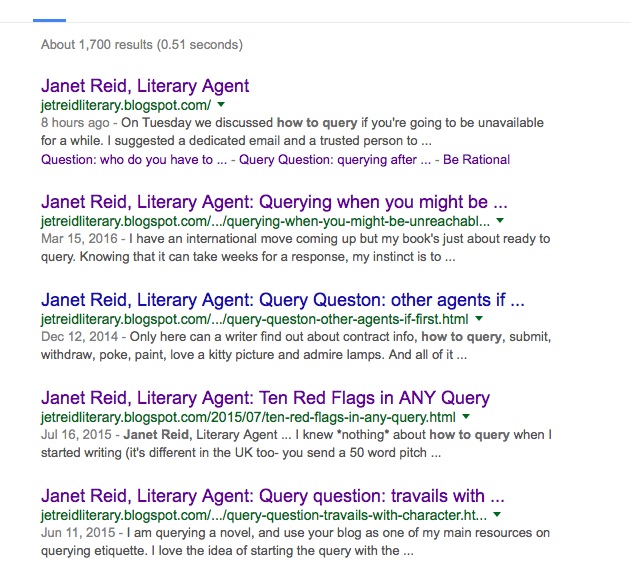
My original instructions were to google using search terms "how to query" and the agent's name for example "janet reid"  When I actually googled here's what I got:


Not only is that not helpful, if you click on any of those links you're diving in to a rabbit hole of unfamiliar terms. Plus, it's not the answer to your question.

I thought maybe it was just me, since I have a pretty big electronic footprint. I tried a couple names of colleagues. SAME results: lots and lots of entries from Twitter contests, interviews, conference biographies, and buried deep on the 12th page of search term returns, what you're actually looking for.

So, what to do:
1. Find out which agency the agent is associated with.
2. Find that agency's website.
3. Look for "how to query" "how to submit" "how to send work" or similar phrases in the tabs, or in the "about us" section.

Sometimes you'll have to look at several different pages to get all the info you need. Here at FPLM our email addresses are on "Contact me" and what we're looking for is listed under "agents"

Each agency website is configured differently.

Some agencies use one email address for all agents at the agency.
Some agencies use one email address for each agent, and you query the agent directly.

One is not better than the other. There is no real "industry standard" on best website layout!

Generally there will also be some guidelines on what the agent is looking for (fiction or non-fiction, maybe both; what kinds of fiction, etc.)

There will be some guidelines on what to include in the query letter: your bio, what the book is about, a synopsis, etc.

Don't assume you know what these things (like synopsis) mean. Publishing has its own unique vocabulary like every industry.  You can google "what is a book synopsis" for help. Make SURE to include the search term "book" or "novel" so you're not getting information on how to write a synopsis of something else.


What you send to the agent you're interested in working with is called a query letter.

A query letter is a business letter that tells an agent about you and your book. It's not something you'll dash off quickly, because it's the ONLY thing an agent will see from you about your book.

There are lots of good resources on how to write effective queries. I happen to be fond of QueryShark.blogspot.com because I write that blog. Start with the first query posted, and read them all.


Give yourself time to learn something about publishing before you dive in.

This is akin to moving to a foreign country where you know none of the customs and very little of the language. Things are strange, expectations are weird. The only thing to do is watch and learn for a while.

You'll start to get it after a while. The secret is patience.

I know you're tempted to ignore this. I"m so good at my job I can actually hear you thinking "this is nuts, I don't need to do this. I don't want to waste time doing this." The truth is you do. Agents hear from a lot of people and one of the first things they consider is how effective your query is and how prepared you are. Querying too soon is a common mistake. Maybe you've already gotten a lot of silence from those Tweets, or Facebook messages?

Silence doesn't tell you what the problem is. And you'll just assume no one likes your book or wants to work with you, when in fact the truth is no one got past the packaging to actually consider your work.

There are several posts on this blog labelled Publishing 101 which should also be useful.


Thursday, June 04, 2009

How soon is too soon?

The most common mistake writers make in the query process is querying too soon. But how soon is too soon?

It's too soon if:

1. You just finished writing the novel. Writing a good novel isn't about writing; it's about revision. Revision takes time. If it took you a year to write the novel, it will take six months to revise it.

2. It's your first novel. No matter how hard it is to hear and follow this advice, it's probably the best advice I'll ever offer: write a second novel before you query on the first one. You'll learn so much while writing that second novel that you'll go back and either revise or discard Novel #1. AND you won't have all the baggage from those damn form rejections to weigh you down

3. You don't have a polished one page synopsis. Writing a synopsis is torture. I know it; you know it. It also is an incredible writing tool. If you can't get your book to make sense in synopsis form, you have a problem with the BOOK not the synopsis.

Your desire to get past the query stage to publication stage is the biggest block to actually achieving your goal.

Saturday, August 26, 2017

Follow ups to yesterday's questions

The comment section brought up some good questions on Monday's and yesterday's posts

Laura Mary
I have a question prompted by Monday’s post where you complained about people not sending pages…
So agents like to keep us on our toes, some like a synopsis, some like a query, some like a belly rub, some are strictly scratch behind the ears only. Some ask for pages, some don’t…
Would it be a really bad idea to just always send pages? If you’re sending 100% of the correct information asked for, is it a terrible, terrible thing to send extra? Are you saving time if they want to read more, or are you showing that you can’t follow rules and shooting yourself in the foot?
Now that I’ve written this out, I suspect there is no real answer, it will just depend on the agent, and how good or bad a day they’re having!


You're right. It's impossible to know the answer. I think agents who discard queries that don't follow guidelines to the nth degree are missing some good stuff, but I throw out stuff that has a synopsis rather than pages, so there's that.

I think pages are always a good idea, but some agents are hugely prickly about sending only what is asked for.

If an agent doesn't ask for pages, and you just have to send pages, at the very least, put them at the BOTTOM of the email. And leave out "I know you didn't ask for it but here are pages" cause that just alerts me to the fact you KNOW what I want and don't care.

If someone is sending me a synopsis (which I don't ask for) and it's the first thing I see after the query, well, sayonara baby, it's a pass.

If someone sends me a synopsis AFTER the pages, I don't read it, but I do read the pages.

There are ways to break the rules without shooting yourself in the foot.

Theresa
As for #2: Wow! Why would anyone ever, ever comment on someone's photo? As a lady person, this would cause me to press to reject button, no matter how excellent the query.

You are so so right. When this query got passed around, you could hear the ice forming on keyboards and strangled yelps of outrage.

My best guess is this query writer thought he (of course it was a he) was being folksy and charming. What lady doesn't like being told she's attractive? In other words, he's tone-deaf, and clueless. Just exactly what I'm NOT looking for in an author (or anyone actually.)  If you are a gentleman and worried about sounding clueless and tone-deaf, you're probably fine. The C and TD are noted for being oblivious, not worried.


Susan
When writing the story portion of the query letter, is it wrong to treat it as if you're writing a back-of-book blurb in that you want to entice the agent the same as if you'd want to entice the reader? Or are there more elements to consider in the query (not including the word count, comps, and bio)?

The reason I don't say "use the back of a book cover, or flap copy,  as a model" is that often they  sound like reviews.

Example:
This is Winter's Tale by Mark Helprin


 Notice the "transport you" and "one of the most beautiful and extraordinary stories of American literature." Neither of those are things you want to include in a query.

Example:
This is Jilo by JD Horn


Everything's jake until that last paragraph.


Both examples are very well-written jacket copy.
They're just not the best thing to say in a query.


Mark Ellis
If your novel is high-concept, is having the query/pitch/idea on public display problematic? 
No.
You have seen it for yourself here on the blog: five prompt words and not a single story is duplicated.
Authors worry about this a lot because they think it's the concept that sells the book.
It's the concept that gets me to READ the book.
How you develop that concept, write your characters, get plot on the page, surprise me: that's how I sell the book.

I could hold a flash fiction contest with a very good high concept idea, and I'll bet you painting my apartment for me that no two entries would be similar enough to look plagiarized.