I’ve published two novellas via Amazon Kindle under a pseudonym. They’re not fantastic, not terrible, sold okay...but now I’m preparing to query traditionally and I plan on querying and (hopefully) getting published under my real name. Should I even bother bringing up the pseudonym-self-published books?
Yes. You say just what you said to me here: "I've published two novellas under a pseudonym" and leave it at that. It's important to mention this only because your agent needs to know you've got some publishing history. It won't mean the difference between yes or no on this new novel, but it can mean the difference between debut/not a debut. You don't want to discover the hard way that your agent has been pitching you as a debut if you're not.
I want to make the trip to my website worthwhile for readers, so I'm including some samples of my writing. My question revolves around published short stories in general and one in particular. I'm curious who owns the rights to a short story where I wrote it and a publication accepted it, and then paid me and published it. In this particular instance, I'm pretty sure the magazine is now defunct. Is there a timeframe when rights revert back to me so I can publish on my website or did I sell all rights and I can never post it on my website since I no longer own the story?
There is no one answer for this. The answer is found in the contract for publication that you signed for the short story publication.
What you're looking for is the word "exclusive."
If the magazine licensed exclusive rights to publish this story electronically or in print or both, then they have the rights. Hopefully it's for a limited amount of time.
If it's not for a limited amount of time, then they still have the rights and you need to get them back. That's called a reversion.
If the contract said "non-exclusive" for electronic use, you're ok on your website.
If you did not sign a contract, and the magazine appears to be defunct, you send a letter saying you're reclaiming your rights. At least this way you've made an attempt to contact them. In the actual real world, you're probably ok with publishing your own work on your website. Things get a LOT trickier when you want to include anything previously published in a new book (like an anthology)with a company that's got some money and an insurance policy: their deeper pockets attract lawsuits. The bottom line: as a writer, you must keep good records of where you've published your work and on what terms. This is not something you'll do "when you get around to it" because when I need to know if "Felix Buttonweezer Buys a Shi Tzu" has been published before, "I don't remember" isn't the answer I'm looking for.
I love writing Flash Fiction, using the variety of the challenges as a way to practice my writing while expanding my horizons. In addition, if I see some theme or a group of characters reappearing, that's a signal that there may be a novel in there too. I publish these little stories on my blog, along with the topic involved, and have received helpful feedback on many of them. In addition, hopefully I have encouraged others to try them too.
When I do use some of these as a base for a novel, I re-write and expand the stories, along with the addition of much new work.
However, before I start sending my novel to agents, should I delete all the original stories online? (1)
Should I leave them there and advise the agent about them?(2 and 2a)
(1) no
(2) sure
(2a) no
How you come up with your ideas for your novel is not something I need to know about and often it's not something I WANT to know about. Kind of like making sausage, or Donald Trump's hair. The less I know about how it's made, the happier I am.
When you query me, I'm interested in whether you've written a book I want to read. That's pretty much the extent of my interest.
Later in the process, when you're doing promotion for your book and interviewers ask where you get your ideas, you can talk about the value of flash fiction.
When I first started writing with intent, I completed my first “real” novel. Being youthful in my journey toward publication and filled with flattering accolades from my writers’ group regarding my writing skills, when a subset of that group formed around the idea of self-publishing our rejected books with a commitment to hawk them at local fairs and events, I did publish the book.
I soon discovered several things:
· Unless I was autographing and shoving the book into the public’s hand, sales were pathetic
· I knew next to nothing about marketing globally (or even nationally) through social media or Amazon (did I already admit to pathetic sales?)
· My writing skills were not as mature as my ego testified they were (thus all the agent rejections)
I do believe in the story (it’s loosely based on an unsolved true crime). The heroin in the original novel is a young woman who is abducted and the trail of terror that follows. I know from more than one agent not to query a self-published work. So my question is, what if I did a complete rewrite, changing the primary POV to an FBI Special Agent who pursues the abductee? Once completed, would this be considered pitching a self-published work?
This is a very interesting question.
At what point during a rewrite does a book cease to be a revision, and become a new book?
A POV change is probably a good benchmark.
Your question though is really more along the lines of "are you cheating if you re-purpose a previous book?"
Obviously you won't call yourself a debut author, and you'll make sure the previous book is no longer for sale from you or any one else (that means you buy up any used copies floating around on Amazon.)
And, what's the worst that could happen? Rejection? Well, you're going to get that no matter what book you write, it's part of the game.
Is someone going to come out of the woodwork, waving the self-published book, clamoring for a refund on this new book? Very very doubtful.
The key of course is to write a much better book this time. And given you've gotten more experience, the chances of that are pretty good!
My Facebook page (and other agent's pages too) will sometimes get messages asking "how do I query you."
My first reaction is to reply with this link but then I'm not sure they'd actually get the sarcasm.
Then of course it dawned on me that some folks literally do NOT know what to do first. I was reminded of this yesterday as I was reading a terrific novel about the two people from radically different cultures and their communication problems.
In our case, the two cultures are people who know more than nothing, and those who know nothing.
So, why not offer some help.
Where you come in is giving me some ideas for resources.
Think back to the very first helpful place you found and the things you
needed to know to make publishing not seem quite so foreign.
What follows is my proposed blog post: HOW DO I QUERY YOU and other New To Publishing Questions.
First of all, thank you. This post was originally intended to lay out in very simple terms how to query an agent if you didn't know the first thing about querying. I thought I was being all benevolent and amazing and frankly, I was pretty pleased with myself.
Then I actually tried to follow the directions I was giving. And came up empty handed! Man oh man, did my ego take a good swift kick to the asterisk.
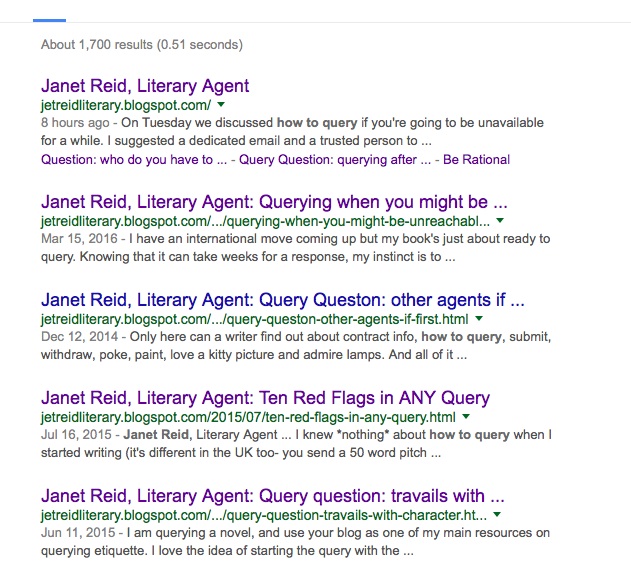
My original instructions were to google using search terms "how to query" and the agent's name for example "janet reid" When I actually googled here's what I got:
Not only is that not helpful, if you click on any of those links you're diving in to a rabbit hole of unfamiliar terms. Plus, it's not the answer to your question.
I thought maybe it was just me, since I have a pretty big electronic footprint. I tried a couple names of colleagues. SAME results: lots and lots of entries from Twitter contests, interviews, conference biographies, and buried deep on the 12th page of search term returns, what you're actually looking for.
So, what to do:
1. Find out which agency the agent is associated with.
2. Find that agency's website.
3. Look for "how to query" "how to submit" "how to send work" or similar phrases in the tabs, or in the "about us" section.
Sometimes you'll have to look at several different pages to get all the info you need. Here at FPLM our email addresses are on "Contact me" and what we're looking for is listed under "agents"
Each agency website is configured differently.
Some agencies use one email address for all agents at the agency.
Some agencies use one email address for each agent, and you query the agent directly.
One is not better than the other. There is no real "industry standard" on best website layout!
Generally there will also be some guidelines on what the agent is looking for (fiction or non-fiction, maybe both; what kinds of fiction, etc.)
There will be some guidelines on what to include in the query letter: your bio, what the book is about, a synopsis, etc.
Don't assume you know what these things (like synopsis) mean. Publishing has its own unique vocabulary like every industry. You can google "what is a book synopsis" for help. Make SURE to include the search term "book" or "novel" so you're not getting information on how to write a synopsis of something else.
What you send to the agent you're interested in working with is called a query letter.
A
query letter is a business letter that tells an agent about you and
your book. It's not something you'll dash off quickly, because it's the
ONLY thing an agent will see from you about your book.
There are lots of good resources on how to write effective queries. I happen to be fond of QueryShark.blogspot.com because I write that blog. Start with the first query posted, and read them all.
Give yourself time to learn something about publishing before you dive in.
This is akin to moving to a foreign country where you know none of the customs and very little of the language. Things are strange, expectations are weird. The only thing to do is watch and learn for a while.
You'll start to get it after a while. The secret is patience.
I know you're tempted to ignore this. I"m so good at my job I can actually hear you thinking "this is nuts, I don't need to do this. I don't want to waste time doing this." The truth is you do. Agents hear from a lot of people and one of the first things they consider is how effective your query is and how prepared you are. Querying too soon is a common mistake. Maybe you've already gotten a lot of silence from those Tweets, or Facebook messages?
Silence doesn't tell you what the problem is. And you'll just assume no one likes your book or wants to work with you, when in fact the truth is no one got past the packaging to actually consider your work.
There are several posts on this blog labelled Publishing 101 which should also be useful.
Mystery Writers of America has a call for middle grade submissions for their next anthology, edited by R.L. Stine. You MUST be an MWA member to submit work. Let me know if you want the announcement (email me)
Words I got wrong this week: loath/loathe
Words I did NOT get wrong this week: deserts/desserts. How you
would know though, given my decline in spelling standards, I do not know.
Last week's review had mention of mailing pumpkins and
watermelons.
Jenny C said
Now that Janet has posted on WIR that I'm willing to write my
synopsis on a pumpkin and mail it off to agents I expect to get inundated with
requests tomorrow morning! So I'm off to buy a package of Sharpies and a bunch
of pie pumpkins, which my local grocery store sells year-round. If no one
requests? Well, I can always make pie.
Does anyone else want to see the synopsis on the pumpkin? Yea,
I thought so! Ok, Jenny, pics or it Did Not Happen!
Lennon Faris asked about the term "monkey knife
fight"
And monkey knife fights! who are the monkeys? editors? agents?
both? Is there screeching, or stuff thrown around the room? It's something I'd
like to see.
This is a term I stole shamelessly from La Slitherina Herself
Barbara Poelle. It's how she describes agents warring over good manuscripts.
I've never been in one myself. I just swim up silently and grab the writer from
below and swim off to Representation Island, leaving all those other agents
splashing around in the Sea of Sorry.
Celia Reaves asked about the marathon editing project that
sucked up a lot of time recently:
I hope your editing project has been put to bed and the
demands on your time have ratcheted back down from astronomical to their normal
level: superhuman.
I finished the last of the line edits on Friday night and
thesense of relief to have finished
was overwhelming. This has been on my to do list since last November!Now all I need to do is write the
actual letter and then Monday, off it goes in the mail.It's been a while since I edited on
paper and I'd rather forgotten how much more I like pen and paper than I do
electrons.Plus, my pen collection
got a good workout!
The pens for this ms are the ones in the far right front mint julep
cup.
And a tip of the sailor cap to John Frain's downright awful pun:
Amy, you can't blame your kids when they're naughty-cal, you're raising 'em that way.
(for those of you not aware: Amy lives on a boat)
luciakaku contributed to the unicycle theme from last week:
One of the most surprising things I discovered upon moving to
Japan is that Japanese elementary schools keep racks of unicycles for the
students' use. The kids ride unicycles during recess. Bigger kids help little
kids learn. I've had a few schools do synchronized unicycle dances for big,
sporty presentations.
And Youtube brings you the world:
On Monday we talked about being careful not to burn bridges in
this small world of publishing.
Adib Khorram asked:
I hope I haven't been operating under bad information, but it
has been my understanding that at the query stage, there's no need to reply to
a rejection at all, unless it was a personalized/helpful one (in which case you
should say thank you). Otherwise, even short "thank you" notes to
form rejections can quickly add up and clog an agent's inbox.
Now I hope I haven't been inadvertently rude.
The woodland creature brain is at it again.
You have not been rude. It is perfectly polite to not reply to
rejection letters. I actually prefer it in that it helps me keep my email under
control. I understand that some people simply can not help themselves and must
reply, so "thank you for considering my query" is just about the only
thing you want to say.
Jennifer R. Donohue's mouse story made me laugh
I've worked with people, frequently the general public, in
every job I've had. While I'm not surprise, per se, to learn new wrinkles of
bizarre/ridiculous/more or less unacceptable behavior, I still look askance.
Example: a couple of weeks ago, a patron for some reason pulled one of those
business reply envelopes from a library trash can. There was a dead mouse in
it. Then they could not conceive of any other scenario than "a person was
going to mail this dead mouse to somebody and changed their mind". After
about ten minutes of listening to this patron go back and forth with my
coworker, I finally weighed in with "How about you just stop taking things
out of the garbage and it won't bother you." And so the poor mousie
returned to its erstwhile graveyard.
So there we have it. At least somebody didn't mail you a dead mouse in response
to your rejection.
As someone who has disposed of dead rodents I can tell you
exactly what happened: the mouse is dead and the person who found it didn't
want to touch it. An envelope is a perfect mouse shroud.
Why anyone would think it was intended to be mailed defies
logic. Amazing.
This from Bethany Elizabeth (after a discussion of how to
spell asshat) cracked me up
DLM reminded me of a game my friends and
I would play. Whenever adjective-ass noun was used (big-ass test, nice-ass car,
kickass hat) we would switch the hyphen (big ass-test, nice ass-car, kick the
asshat).
And in the end Brian Schwarz has exactly the right thing to
remember:
I wanted to take a moment to admit a dangerous thing. On one
particular occasion, on a very bad day when I was in a dark and desperate
place, a personalized rejection rubbed me the wrong way and I got hooked.
I know, I know, a big no no on my part.
It wasn't a long exchange. I'm sure the agent was giving helpful advice by
telling me my plot could really use some work. It just hit me at the wrong
time, and I replied with something snide. The agent came back with something
equally snide, and I'm sure I made the blacklist for that agent's spam folder.
At the end of the day, I bit when I shouldn't have. It didn't go well. I did
know better. And I shouldn't have done it. But life goes on. So if you're
sitting there thinking "Shit...I really wish I had read this post 4.23
minutes ago before I hit reply to that form rejection..." -- just take a
deep breath and keep going. We get caught up in this stuff sometimes, the do's
and don'ts, but even when you're well informed, you might still eff it up once
in a while.
Two
questions... How do you raise the question? Does the agent's answer mean all
that much at that point?
After all, if you've been offered representation than at that moment the
agent believes they can sell your work. Some time later said agent changes
agencies and now realises maybe it's too hard a sell. So for all the positive
talk you might have got at sign-on-the-dotted-line time you're left on the
sinking ship.
You'd ask '"what happens if you can't sell this" and
"what happens if you change agencies?"And yes, you're right none of us know what the future holds, but this way, you've asked, and you won't kick yourself later for NOT having
asked.
Brigid asked:
Wait, but if those editors passed on it would this project
then be dead in the water? The way that it would with an agent who only queried
10 editors and said sayonara?
Yes. I think what the Departing Agent intended here though was
that if there was an offer, she'd let the author take it to a new agent so the
author had something of immediate value to query with.
Jason Magnason asked:
If I query an agent, and I get a request for a full, and I get
signed, then can I expect that they are prepared for the hard questions?
Will an agent be upset if I ask, "So if you move to a new agency, are you
going to take me with you? Are you in this for the long haul? Are you going to
shop this book till the heels on you shoes break?"
Yes. No.
All agents should be prepared to answer these questions. Any
agent that gets huffy about this…well, now you know something about them.
Of course, you're not going to ask this like you're
interrogating them about the disappearance of the last pint of Rocky Road from
the freezer,but you still should
be able to expect answers to these and other "before you sign"
questions.
I've blogged about the Next Questions you ask an agent before signing before.
E.M. Goldsmith asked:
Is there a disadvantage to being the only author in a genre in
an agent's wheel house? Or am I better off with someone who has dozens of
hardcore fantasy writers?
I think a lot of this depends on the agent and the agency. I
have several "one-offs" in my list. Laird Barron writes cosmic
horror. He's the only guy I represent who does. When people write to me with
horror novels I always say no. Laird's career is busy and multi-faceted and I want to
focus on him. Horror is a limited market and I don't want to
divide my efforts between two writers. That's MY approach though, certainly not
some sort of standard to judge by.ASK the prospective agent about his/her approach on this.
BunnyBear asked:
What is the standard contract language concerning who the
Writer is signing with - the Agency or the Agent? I would think that would
enter in when the Agent decides to dump the Writer for said reasons.
There is no standard contract language for author/agency
representation. And this situation is less about the contract than the
practice. For example, my clients at Fine Print are clients of the agency. Were
I to leave, I would drag them with me, unless they wanted to stay. However, if I didn't want to, they are still repped
by the agency as a whole. In practice however, you want an agent, not an
agency. You want an advocate, not just someone who can process your royalty
statements.
One of the big values of hanging my shingle out here at FPLM
is for what happens when the parting of ways is brought on not by a new job,
but by a new plane of existence: if I get hit by the crosstown bus, my clients
are not left wondering who has the keys to the office and where their contracts
are.
And I really like what Craig said:
Seriously, agents are only human and have just as many quirks
and foibles as us who fashion ourselves as writers. Sometimes the world gets
too scary for everyone and some have to drop out or cut back.
It is a shame that when an agent stumbles it looks like they stomp the life out
of some writer. If a manuscript or writing style is good enough for one agent
you can find another that should work out better. Don't lose heart in either your
writing or in humans you put your hopes in. Things do often get better in the
long run.
Jason Magnason asked:
A friend of mine, who I have done some work for, from Colorado
also said that I should not muddy the waters with a bad query. He said send it
to about four agents, if you don't get a response you know its your query. If
you get requests for pages and get no response, you know its the writing.
Either way you know what needs fixing.
Janet, what's your take on that advice?
Bilgewater. You can't know anything from just four agents.
Maybe MAYBE 20 agents, but even then, this is a subjective industry. If you're
not getting requests from your query, get some face time with an agent
(conference, consultation, etc) and get some feedback. It's amazing the number
of ways authors can shoot themselves in the foot in a query.
Isn't this like one man with a couple of sister-wives. Sounds
great, actually sounds quite fulfilling, but oh how difficult it could be when
one likes rap and the other is into opera.
I'm all in favor of plural marriage (no, really I am) and I
like both opera AND rap but I'm not intending to write or perform either. One
can appreciate many wonderful things, but when you turn your hand to creating
art, I'm absolutely convinced that focusing on one thing is the way to go. You
don't notice Yo-Yo Ma taking up the clarinet now, do you? In fact Mr. Ma may be
able to play several instruments up to and including the kazoo and the cowbell
(MORE cowbell!) but his performance instrument is only the cello.
RachelErin had a terrific idea, one I wish I'd thought of when
I wrote the blog post:
The other thing for the OP to consider is genre mashings. If
you decide MG is where your heart is, why not write an MG historical crime
thriller? Which both myself and my 8-year-old would immediately put on our TBR
lists.
Something like The Apprenticeship of Lucas Whittaker, but with a crime element
instead of the medical mystery? (That book made me cry, by the way. The author
did a brilliant job putting the reader in historically empathetic shoes).
MG is a category, not a genre, but this idea is terrific.
(Category= fiction/non-fiction, adult, YA, MG, picture books. Genre: western,
romance, crime)
Robert Ceres makes a good point here:
Writing good MG voice is really hard. Great MG voice, nearly
impossible. I think that is one of the reasons the genre is tight. If you can
write great MG you should go with it, even if you can't get Janet as your
agent. Speaking as a parent, those kids are hungry to read, there is just a
huge shortage of titles with really great writing. The ones that get it right
have been huge sellers. Just my two cents.
I liked the point Her Grace, Heidi, the Duchess of Kneale
makes here:
Sometimes it takes an author a while to figure out what they
really, truly want to write.
I experimented with different genres, different ages, and pretty much wrote out
all those stories that nagged at me until I got my Muse under control. Now my
Muse aids me to write what satisfies my soul--Fantasy Romance novels.
Yes, I loved writing my contemporary thriller. I think it's clever. But it is
the only contemporary thriller I will ever write. One book does not make a
career.
I wrote a contemporary YA and half-way through, asked myself, "Why am I
writing this? I don't love this." Turns out, it was a bad book, possibly
one of the worst I'd ever written.
But I have written several fantasies and several romances. I am happiest
writing Fantasy Romance. Give me love and magic any day.
(But not paranormal. Too close to contemporary. I write escapist fiction. I
want to get as far away from real life as I can.)
Just today I read a guest post on an indie blog about an indie author who only
wrote "when inspired", and whatever random idea that was. She was her
Muses's b!tch. Her works (which apparently there were plenty) were eight ounces
of milk without a glass. Her blog post was about how, after so many singletons,
she was able to write a sequel (after how many years of her fans asking for
sequels?) and that she didn't think she could write a sequel again.
Did she choose the indie life, or did it choose her? I wonder how well she
sells with her scattershot career.
Being a successful career author means having a brand. And that means when
readers see a book under your name, they expect a certain thing. Nobody expects
to pick up a Stephen King book and find a frothy Regency Romance.
My advice to Opie is write your YA, write your historical crime, then write
another book. Maybe two. Ask yourself, what do you want to write the most? What
sings loudest to your soul?
It seems too many people write one book and think they must immediately go out
and seek representation.
Must you?
It seems too many people try to build a career out of one book.
Is it the right book?
And this from CarolynnWith2Ns is spot on:
Kae, for years I wrote what I thought "might" sell
better than what I "loved" to write because I believed my writer's
passion-projects would languish. I don't do that anymore.
If you're going to commit to the huge amount of time writing projects require
you might as well love what rattles around in you brain.
Mister Furkles asked:
You mean LGBT erotica and MG Christian historical don't mix?
WTF? Now, what am I going to do? Maybe one of those double novels with LGBTE on
one side; flip it over and MGCH on the other.
Which was hilarious until I saw this tweet from FPLM agent
Penny Moore this morning:
I have a short list of projects that are just revolting (yes,
dino porn is on that list) and this is one of them!
Michael Seese references one of my favorite scenes in film:
Agent One's advice reminds me of the scene in
"Amadeus" where the Emperor tells Mozart to fix his opera.
"Just take out a few notes."
"Which notes did His Majesty have in mind?"
I often think of this when I'm talking to writers about
revisions. Particularly when I'm talking to them about paring down.
Christina Seine had a good suggestion:
Opie's question reminds me of a thing they used to do on one
of those game shows. I think it was The Price Is Right. You had to guess the
correct price of a car or something, and you'd get a certain number of tries.
So you'd start with your best guess, and they'd tell you how many numbers you
got correct. So the first guess you might have two numbers out of five correct,
but then you change three numbers and lo and behold, now you've get only one
right. So you are blindly changing things just to change things. I never did
see anybody actually win the car that way.
I'm just going to throw out there that reading Larry Brooks' STORY FIX helped
me IMMENSELY with my rewrites. I'd gotten a bunch of fulls and a couple
R&Rs, all of course with conflicting advice. His book helped me see things
from the macro level on in, and I finally had a huge epiphany. Now I think I
know what the agents were trying to tell me. Time will tell, I guess, but in
any case, at least I have a MUCH clearer vision as I finish up revising. Just
can't recommend that book enough.
S.P. Bowers said:
I received an R&R from an agent saying only that it needed
more world building. World building is an exhaustively huge area and I had no
idea what aspect of it wasn't working. I'm still waiting to hear back since I resubmitted.
Sometimes you just have to do what you think is best and hope it checks the box
the agent wanted. Good luck opie.
Well, that could have been me. I've said "this needs more
world-building" to more than a few querying writers.By world building I generally mean you
need to add the furniture to the room.
I copied the reading list and questions for a seminar on
world-building offered by an author recently (and of course forgot to note which
author, but somehow I think it was Alexander Chee)
Here's the list of questions;
What are its primary features: spatial, cultural, biological,
fantastic, cosmological
What is the world's ethos (the guiding beliefs or ideals that
characterize the world)?
When analyzing world building in the reading list: what are
the precise strategies that are used by its creator to convey the world to us
and us to the world? How are our characters connected to the world? And how are
we connected to the world?
Friend of Alex: Have you considered asking Alex yourself,
"Hey buddy, I know you've gotten a ton of rejections, have you considered
hiring an editor or signing up for a workshop? Maybe someone in a class or with
some experience would be able to identify some things you could work on to
increase your chances of success?"
Or even, "You know, back when I was querying, someone suggested I sign up
for a workshop and examine my writing a bit more, and boy did it help to hear
from people whose job it was to help me! And I learned a lot about writing from
hearing other writers' work, too!"
I like Lydia D's suggestion here too:
That's certainly a rough position to be in. Kudos to Opie for
caring about Alex's success and feelings. Perhaps opie could try suggesting a
specific craft book or writing blog to Alex? That takes less investment than a
workshop, so maybe Alex would be more likely to try that. Ultimately, though, a
workshop would probably do a world of good.
And what Dena Pawling said too:
I can only help another attorney who wants me to help. And I'm free to decline
anything I don't want to do. I think this applies here. If Alex doesn't want
your advice, there isn't much you can do. And who knows? Maybe he's on to the
new, big thing. On the other hand, if you want to help him and/or steer him in
the right direction, please do, but be prepared for responses similar to what
an agent must hear when offering a personalized rejection – (1) silence, (2)
much gratitude for the help, (3) constant requests for more help, (4) flaming
response requiring purchase of new computer, (5) stalking, and/or (6) broken
heart.
Sometimes it's sad to sit on the sidelines and watch. But Alex is an adult and
responsible for his own mistakes, his own improvement, his own destiny. And who
are we to say we know better about that destiny than he does?
Marie McKay said what a lot of you were thinking:
I'm a little freaked out by this, if I'm honest. The constant
worry that I'm deluding myself is never far from my mind. I guess when there
are enough signals that are telling you that you need to change, you have to
take notice. I suppose the problem lies in not learning and therefore not
improving.
If you're worried about this, you're ok. If you're worried
about this it means you're not just blindly assuming you're ok and it's only a
matter of time before someone recognizes you're a genius.
It's exactly akin to the people who think they're going crazy.
They're not, because when you are crazy you think you're normal.
Which reminds me of a surreal experience I had with an acquaintance
who was telling me how she got locked in the psych ward of a hospital by
mistake. She was so calm and normal about it that it took a good five minutes
of her (non-stop) recounting of the story before the light bulb went on and I
realized it was NOT a mistake at all. She'd truly had a break with reality, and
her friends who left her there "by mistake" had in fact, signed her in on
doctor's orders.
Susan had a good point about the value of writing WFH novels:
I wrote five novels as a ghostwriter with my writing partner.
It was her world and under a pen name, which I was happy about because they
were very different from what I usually write (and the types of books I want to
publish). But it was a lot of fun, great experience, helped me make some
substantial money, and, most importantly to me, helped me get back into the
writing game after a few years' hiatus. Along with that, it helped me really
cement the types of books I personally want to write.
Dena Pawling made a very good point about "straight forward
contracts"
All standard and/or boilerplate contracts favor the party who
drafted the contract. That's not you.
Some of you read WFH as WTF which made me laugh at this from
Theresa:
WTF, I'd be willing to give WFH a try.
On a general blog decorum note:
Lydia D said:
(I feel awkward joining in the conversation without justifying
why I've popped out of nowhere, so allow me to add a quick note of explanation
for myself: I've been a Reider for a pretty long time now, even delving into
the archives a fair bit, but this is only my third comment.)
All blog readers are welcome to comment at any time. Often,
not-often, on topic, or not. Succinctly and on-topic is generally good. At
length and off topic is generally hilarious.I'll let you know if you're going too far astray.
Sadly, we are retiring the classic subheader about the Shi Tzu this week. Here are the choices for this week:
Burn that bridge when you come to it.--Bethany
Elizabeth
Guerilla kindness really is contagious. Why not be the
flashpoint of kindness in someone's day? --Julie M. Weathers
Y'all ain't right. --DLM
It's a universal truth writers are crazy, but they don't all start out that
way.-Julie M. Weathers
You're in a beautiful mess.--John Frain
And the one I'd really love to choose, but can't cause it
requires context, and truthfully might be offputting to some of my more secular
readers, but I love love love this:
Apparently even God wants me to read this blog. --Lennon Faris